In a relational database a value is a cell — the string CU1061 appears in the
customer table once and in the orders table five more times, six independent copies that happen to spell the same
thing. In AtomicDB a value is an item, stored once per concept, and
every record mentioning it holds an association to that one item.
An illustration: a customer, a country and a product, copied across a CRM, an ERP and a billing system. Watch each copy resolve to a single item in the AtomicDB grid, and each record keep an association to it — consolidation without a pipeline or a target schema.
What a column means — CUSTOMER ID,
COUNTRY, FUEL. The concept carries the meaning, which is why
there is no semantic layer to maintain separately.
One distinct value under a concept. CU1061 exists exactly once under
CUSTOMER ID, no matter how many records mention it.
A record holding an item. Six orders mentioning that customer hold six associations to one item — so the relationship is present in the store the moment the data is.
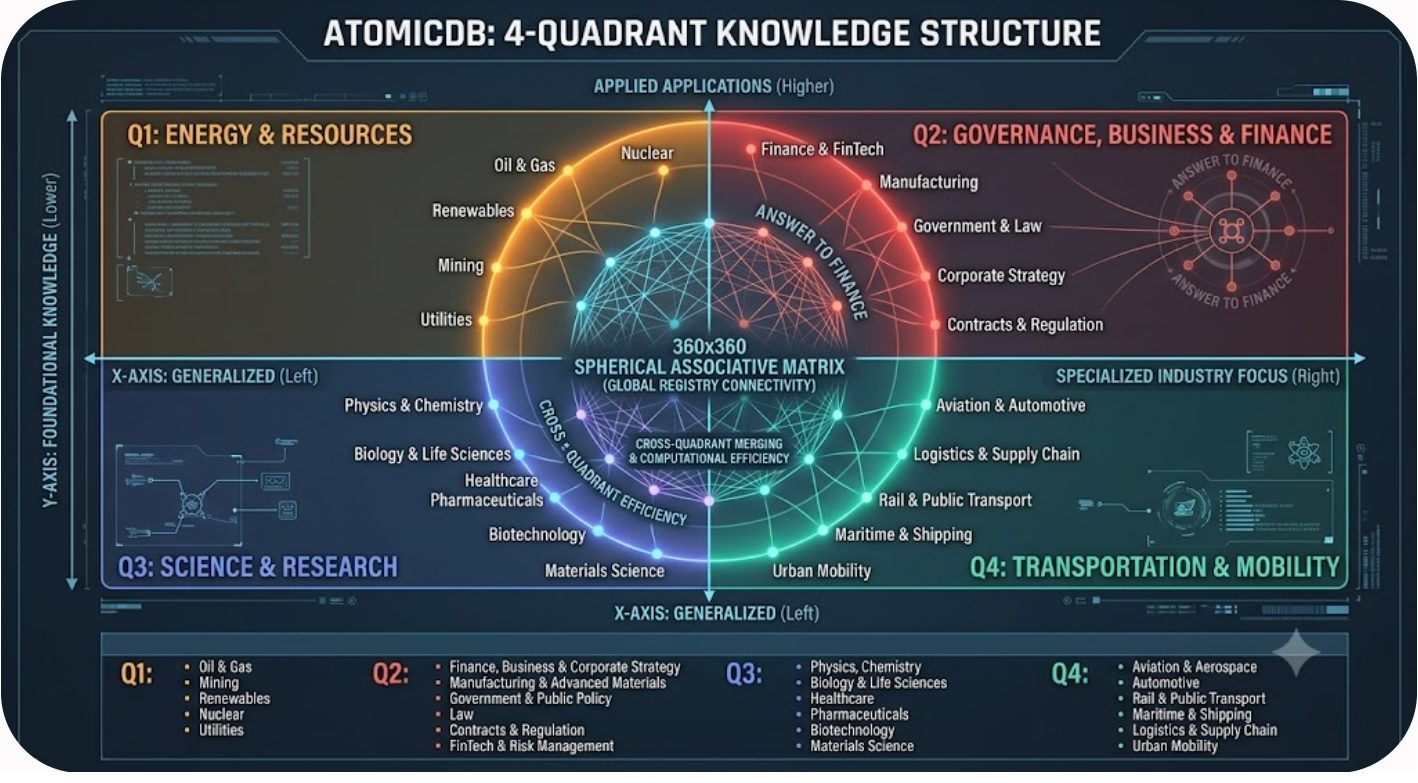
the edge that already existsThe scope boundary. Models live inside knowledge areas, grouped into quadrants, and a question can be confined to the areas you tick — all the way down through reasoning.
scope is a correctness controlThree systems from different parts of a business. Nobody declared a key between them. Select any value below and every record pointing at that one item lights up — across all three.
JOIN … ON was written. Testing whether two records
are related is an identity comparison — do they point at the same
item — not a string comparison.
The unified view is computed when you read it, in two passes. Step through them.
Four records from three systems, each holding only the columns its own system knows about.
QUANTITY = 3 from being treated as related. The fold repeats until nothing changes,
so a link discovered late still pulls in the attributes of a dataset consumed early.
A warehouse restructures information twice: once on the way in, so heterogeneous sources conform to a load contract, and once on the way out, so the conformed data is shaped into a dimensional model an analyst can query.
Both are artefacts of storing values as cells in tables. A store that holds values as shared, addressable items does not need either one.
Pure C, one process. Holds the association hierarchy in memory and the row store beneath it. Session-gated on every read and write.
Append-only, CRC-chained. Data events in sequence; administrative events in a separate write-only audit store. Corrections retire rather than overwrite.
A separate pure-C process that reads the knowledge base read-only, reasons over it in memory, and writes conclusions back into its own two areas.
Ask, JADE, FIPA, MESA, Quantum, speech in and out — each a small native process on loopback, each reading the same store through the authenticated path.


A document that omits them is not useful for a decision. These are measured properties, not caveats.
The model is the argument, but the Mapper is where you watch it pay off.