Home / Applications / VINTNER
In design · reference deployment: an estate winery in Prince Edward County, Ontario

From vine
to glass — and back.

VINTNER is a complete vineyard and winery management system designed natively on AtomicDB, with CAMS as its application layer. Property, vines, harvest, cellar, labels, inventory, sales, contracts, logistics and finance — every step traceable, every rule enforced as the work happens, every funding programme computed from live data.

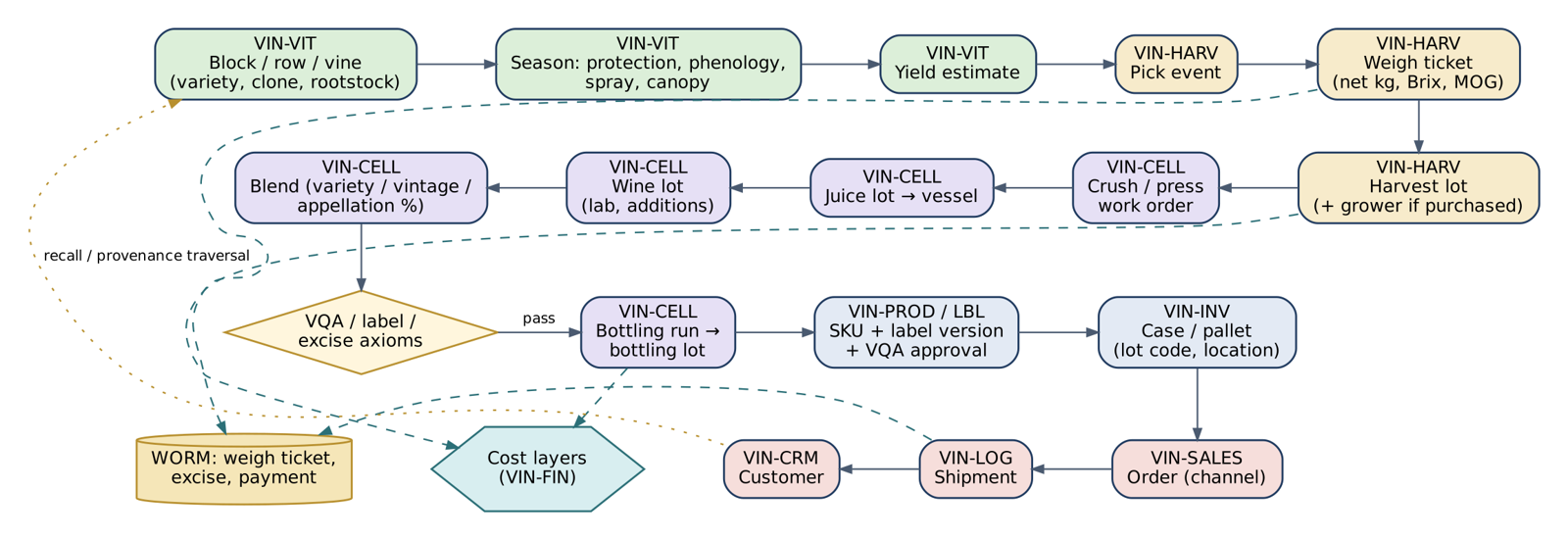
Grape-to-glass traceability

Click any link in the chain.

Each arrow is an association recorded the moment the physical event happens. Pick a step to trace it backward (provenance: which vines are in this bottle?) and forward (recall: which customers received wine from this block?). It is a walk of the AtomicDB grid — not a multi-table join.

Click a step.

Three design choices

What sets it apart from conventional winery software

No queries, no joins

Every screen is a traversal of a model that acts as a filter before access. Recall and compliance answers are immediate and always current.

Compliance as rules

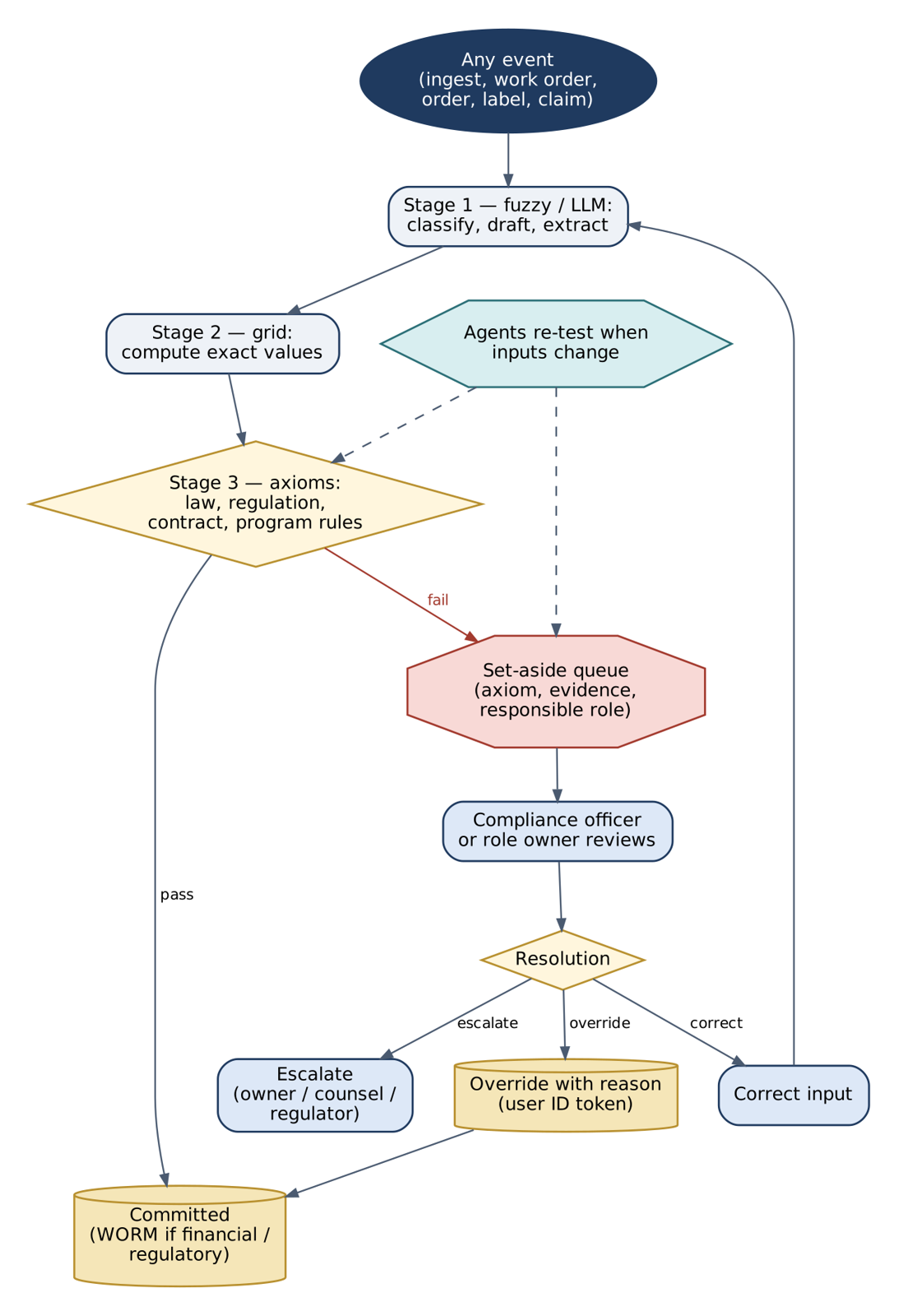
VQA, excise, licensing, labelling, pesticide and workplace rules are encoded as rules. A violating item is set aside for human review — never silently accepted or rejected.

Funding, built in

The system knows which federal, provincial and County programmes the winery qualifies for, computes expected payments from live sales and production, and builds the evidence pack.

Sixteen modules, one record

The whole winery on one grid

Property & assetsParcels, zoning, buildings, equipment, water
ViticultureBlocks, rows, vines, clones, canopy, spray & IPM
EnvironmentWeather, degree days, frost and cold events, sensors
Harvest & intakePick plans, weigh tickets, grape analysis, growers
Cellar & productionVessels, lots, additions, lab, volume and cost
Products & vintagesSKUs, specifications, awards
LabelsA label cannot release while any rule fails
InventoryEvery litre and bottle, by location and tax status
Clients & CRMClub, trade and consumers, consent built in
Suppliers & growersPurchase-to-pay with performance history
ContractsMachine-readable terms the rules can enforce
Sales & channelsAll channels on one stock and one customer
LogisticsFruit, bulk, dry goods and cases, chain of custody
HospitalityTastings, events and agri-tourism
WorkforceCrews, hours and safety, seasonal workers
Finance & complianceLedger, cost by lot, taxes, the obligations calendar
Set aside, never lost

A rule that fails stops the item — and tells a person why.

A violating item is set aside with the rule that failed, the evidence, and the role responsible. An override, correction or escalation is recorded with the resolver's identity. Agents re-test set-aside items when their inputs change — a new lab panel can make a blend compliant.

Ask it in plain language

"Which customers bought any wine from lot PN-26-03?"
"Show winter-injury percentages by block and clone since 2022."
"Can we label the 2026 Chardonnay as Prince Edward County?"
"Which grower contracts renew in the next 90 days?"
Works in the vineyard

Offline in the rows.

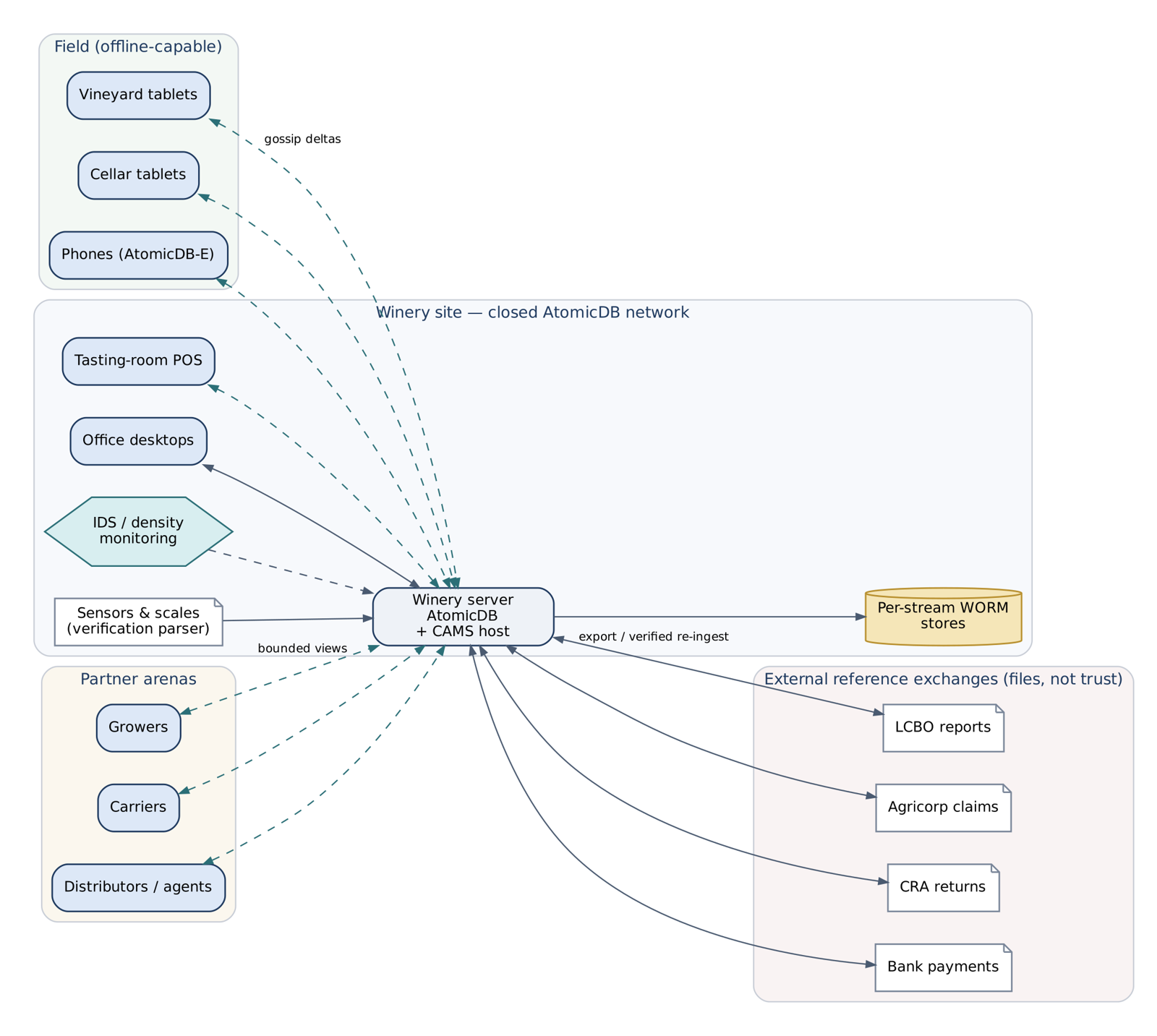
Vineyard tablets, the tasting-room till and phones work fully offline and exchange only what is missing with the winery server when back in range — encrypted, certificate-based, with no cloud in between. Growers, distributors and carriers see bounded views of their own records only.

0
modules
0
sales channels, one stock
0
cloud services required
From the design document
How it fits together

Grape-to-glass traceability chain across the VINTNER knowledge areas
Grape-to-glass traceability — one chain, traversed forward for recall and backward for provenance
Deployment: field tablets, winery server, partner arenas and external file exchanges
Deployment — offline field devices, a closed AtomicDB network at the winery, bounded partner views
Three-stage validation pipeline with set-aside review
Three-stage validation — proposal, the AtomicDB grid, then the rules; failures set aside for a person

Read the full design

Architecture, knowledge areas, all sixteen modules, the compliance and funding engines, process workflows and the delivery roadmap — 51 pages.

VINTNER is in design.

Wineries and partners interested in early access are welcome to get in touch.